What are seller concessions? Seller concessions are when the seller pays a part of your closing costs. Unfortunately, this does not mean you’ll receive those funds in cash or as a discount on your loan. Instead, the seller offers to pay a certain amount by raising the cost of the home. When bidding on a home, you can offer $350,000 and request $3,000 in concessions to cover some of your closing costs. Just expect the seller to counteroffer with a higher home purchase price of $353,000 (with $3,000 in concessions).
Seller concession vs. price reduction: Keep in mind, these are not interchangeable. While a seller concession might provide short-term relief for a buyer at closing, they're ultimately responsible for a larger loan amount. Price reduction, on the other hand, refers to a seller lowering the price of their residence.
Can repairs be covered? Most real estate sales contracts contain a home inspection contingency that illustrates the buyer's and the seller's options should problems be discovered during the home inspection. If a home inspection reveals that expensive repairs are necessary, a seller may offer a concession to offset potential or known repair costs. The seller can also provide a reduction in the sales price, or they can choose to leave the repairs up to the buyer. Depending on repair cost, the sales contract, and the loan contingency, doing nothing could result in losing the deal and having to put the home back on the market. Did you know: once an inspection uncovers an issue, the seller must disclose it to all future potential buyers. Consider staging your home to increase it's interior appeal.
Buyer’s markets vs. seller’s markets? Seller concessions can be used in both buyer’s markets and seller’s markets, although they’re more likely to be granted in buyer’s markets. In a seller’s market, a buyer who requests a seller concession might lose the home they want to another person who’s willing to put more money on the table. However, in a seller’s market with high demand or low inventory, the seller holds all the cards. If you’re in a seller’s market, you could risk having your offer declined. Learn more tips in our who pays closing costs on a home mortgage article.
Disadvantages? As mentioned earlier, closing costs are usually rolled into a buyer’s home loan when there’s a seller concession, making the loan amount higher. With a 3% concession, a $350,000 mortgage would rise to $360,500. So your monthly payments would go up by $55 a month (assuming a 30-yr fixed-rate mortgage at a 4.75% interest rate). You would also be paying $9,218 more in interest over the life of your loan. Depending on your financial circumstances, avoiding the concession might be the better move. Guide: What to know about For Sale by Owner (FBSO)
A "bogey rate" with a Lender credit: Another way to help the buyer purchase a home when they are short the funds needed to cover closing costs is choosing a higher interest rate than the
PAR interest rate to get a Lender Credit to help cover closing costs. This strategy can also be combined with a seller credit.
The bottom line: What's the best way to decide whether or not seller concessions are right for you? Ask your Incredible Lender to explain the advantages in your particular situation. Along with your real real estate agent's knowledge of the local market and your realtor's negotiation skills, you can feel confident you're making the best offer to the seller.
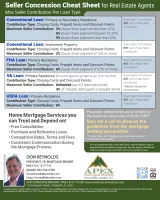
Rules and limits by loan program: The amount a seller can offer is dependent on the buyer’s loan program.
For the Government FHA loan program: The FHA limits seller concessions to 6% of the loan amount. Should your concessions exceed 6%, it will result in a dollar-for-dollar reduction to your home loan purchase price. Consider this example: Say you’re financing a $350,000 home. You’re able to use $21,000 in seller concessions — if the seller agrees to assist you. If you’re given (and use) $24,000, your loan amount will cut back to $347,000. Conventional Fannie Mae and Freddie Mac set the rules for conventional loans, which have a maximum cap based on home price and down payment. The FHA oversees seller concessions to ensure the transaction is fair to both parties. Sellers cannot assist the buyer with the down payment but may be able to help cover closing costs such as: The 1.75% UFMIP (upfront mortgage insurance premium), origination, underwriting & processing fees, discount points, title fees, excetera.
When financing an FHA primary home, the rules are as follows: The FHA limits seller concessions for buyers putting less than 10% down to 3% concessions. If the buyer is putting 10-25% down FHA loans allow a 6% concession. If the buyer is putting more than 25% down, FHA loans allow a 9% concession. Investment homes or second homes only allow for 2% concessions.
When financing an VA primary home, the rules are as follows: The VA loan program will limit concessions at 4% seller's if the concessions are being used to help the buyer pay off debt to qualify for the loan or the concession is being used for other pre-paid items
How can seller concessions be used on VA loans? Concessions may be used for, but are not limited to: Payment of the buyer’s VA funding fee, prepayment of the buyer’s property taxes and home insurance, gifts such as a television or dishwasher, payment of extra points to provide permanent interest rate buydowns, provision of escrowed funds to provide temporary interest rate buydowns and payoff of credit balances or judgments on behalf of the buyer